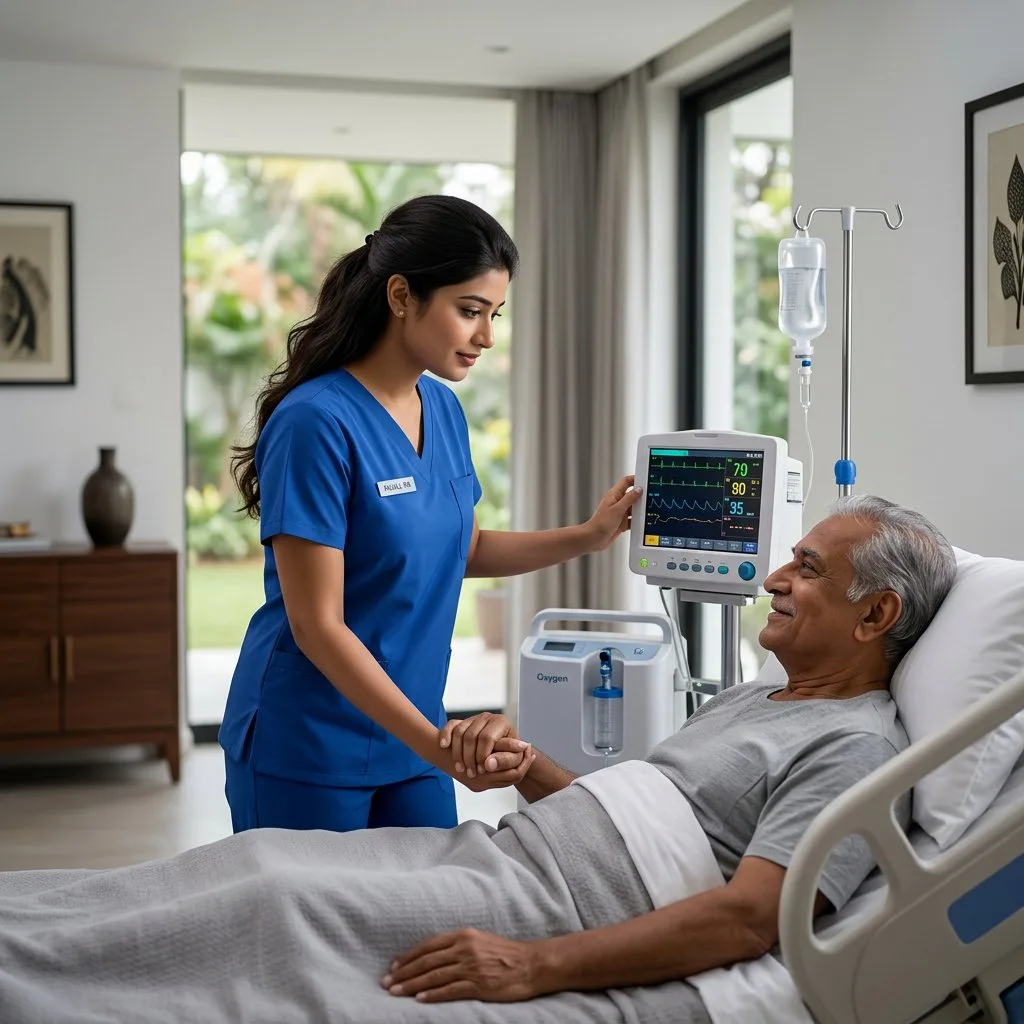
- 15+ years combined home healthcare experience
- Background-verified clinical staff
Medca Healthcare provides tracheostomy care at home in Bangalore including sterile suctioning, stoma site hygiene, inner cannula management, humidification, emergency airway response, and tube change coordination — by registered nurses trained in airway management protocols.
Medical overview
Medca Healthcare provides specialist tracheostomy care at home in Bangalore for patients with artificial airways requiring ongoing suctioning, stoma hygiene, inner cannula management, and emergency airway response. Tracheostomy patients depend entirely on skilled nursing for airway patency — a blocked or dislodged tracheostomy tube can be fatal within minutes.
Home tracheostomy care extends hospital-level airway management into the community for patients with prolonged ventilator weaning, neurological conditions, or upper airway obstruction. Medca nurses maintain sterile suction technique, monitor secretions for infection indicators, perform scheduled inner cannula cleaning, and coordinate tube changes with the treating ENT or intensivist team.
Tracheostomy care integrates with our home nursing services and typically combines with ventilator care and ICU-at-home for ventilator-dependent patients requiring comprehensive critical airway management.
Symptoms & warning signs
- Inability to breathe without tracheostomy airway support
- Thick or blood-stained tracheal secretions requiring regular suctioning
- Stoma site erythema, granulation tissue, or purulent discharge
- Increased work of breathing or desaturation suggesting mucus plugging
- Difficulty passing suction catheter indicating partial airway obstruction
- Weaning progression with reduced ventilator dependence requiring airway monitoring
Common causes
- Prolonged mechanical ventilation requiring tracheostomy for weaning
- Upper airway obstruction from tumour, trauma, or bilateral vocal cord paralysis
- Neurological conditions — stroke, ALS, TBI — with impaired airway protection
- Congenital airway anomalies requiring long-term tracheostomy
- Post-laryngectomy or head and neck surgery airway management
Risk factors
- Inadequate humidification causing tenacious secretions and tube occlusion
- Poor stoma hygiene leading to peristomal infection
- Accidental decannulation in patients without established stoma tracts
- Cuff over-inflation causing tracheal mucosal ischaemia and stenosis
- Delayed tube change beyond manufacturer or physician recommended interval
Who needs this service
- Patients with established tracheostomy discharged home with physician clearance
- Ventilator-dependent patients requiring integrated tracheostomy and ventilator nursing
- Patients weaning from ventilation with ongoing tracheostomy airway needs
- Long-term tracheostomy patients needing professional home airway management
- Families unable to safely perform suctioning and stoma care independently
When higher-level clinical care is required
- Patients needing only personal care without tracheostomy should use caregiver services, not tracheostomy nursing.
- Acutely unstable patients in the first 48–72 hours post-tracheostomy belong in hospital ICU until the stoma matures.
- Patients whose families cannot maintain emergency equipment and backup plans at home need institutional care.
Why choose Medca Healthcare
Key benefits
- Airway Management Expertise
- 24/7 Nursing Availability
- Sterile Suctioning Technique
- Bangalore Home Service
- Stoma & Cannula Care
- Emergency Airway Protocols
Clinical care process
- 1 Review tracheostomy type, size, cuff status, and physician airway management plan.
- 2 Home assessment for suction equipment, humidification, emergency supplies, and backup power.
- 3 Airway care plan with suction schedule, stoma care protocol, and emergency algorithm.
- 4 Nurse assignment with tracheostomy and airway management certification.
- 5 Shift-based secretion and stoma documentation with desaturation event reporting.
- 6 ENT or intensivist coordination for tube changes and decannulation planning.
Treatment support & care scope
Clinical & daily care support
- Sterile closed and open suctioning per secretion assessment schedule
- Inner cannula removal, cleaning, and reinsertion with sterile technique
- Stoma site cleaning and dressing with granulation tissue management
- Humidification system maintenance — heated wire circuits or HME filters
- Cuff pressure monitoring and adjustment when cuffed tubes are in situ
- Tracheostomy tube change at physician-scheduled intervals
- Emergency airway algorithm execution for tube obstruction or decannulation
Related conditions
- Ventilator-dependent tracheostomy with integrated ICU-at-home nursing
- Progressive weaning from ventilation with decannulation planning
- Neurological tracheostomy — stroke, ALS, TBI long-term airway management
- Paediatric-adult transition tracheostomy care for young adults
- Head and neck cancer tracheostomy with complex stoma anatomy
- Non-ventilated tracheostomy with secretion management needs
- Tracheostomy
- Mechanical Ventilation
- Airway Obstruction
- ALS
- Prolonged ICU Recovery
Recovery guidance & expected outcomes
- Family emergency airway training without replacing nursing responsibility
- Suction catheter and sterile supply inventory management
- Humidification equipment maintenance and filter replacement scheduling
- Speech therapy coordination for speaking valve trials when clinically appropriate
- Decannulation readiness assessment coordination with physician team
Care team & availability
- 8-hour and 12-hour nursing shifts for continuous airway management
- 24/7 coverage for ventilator-dependent tracheostomy patients
- Scheduled visit protocols for stable non-ventilated tracheostomy patients
- Emergency on-call nursing response for airway obstruction events
Emergency signs — seek immediate help
- Complete inability to pass suction catheter — critical airway obstruction
- Accidental decannulation in patient without mature stoma tract
- Sudden severe desaturation unresponsive to suctioning and oxygen
- Massive tracheal bleeding from stoma site
- Subcutaneous emphysema around stoma suggesting tube displacement
- Cardiac arrest in ventilated tracheostomy patient requiring immediate CPR and airway management
Caregiver & family guidance
Never attempt tracheostomy tube change or deep suctioning without nursing training and authorization. Keep emergency equipment — spare inner cannula, obturator, suction — at the bedside always. Call the Medca nurse immediately for any breathing difficulty, tube displacement, or inability to suction. Humidification must run continuously — dry air causes fatal mucus plugs.
Medical highlights
Medca Healthcare tracheostomy home nursing in Bangalore delivers registered nurse airway suctioning, stoma care, inner cannula cleaning, secretion monitoring, humidification management, and emergency decannulation response for ventilated and non-ventilated tracheostomy patients.
- Sterile suctioning technique maintaining airway patency.
- Stoma site care preventing infection and granulation complications.
- Inner cannula cleaning and scheduled tube change coordination.
- Humidification management preventing mucus plugging.
- Emergency airway response protocols for tube dislodgement or obstruction.
Sub-services
-
Airway Management
Medca Healthcare delivers premium Airway Management solutions, combining clinical expertise with personalized patient care in the comfort of...
-
Secretion Management
Medca Healthcare delivers premium Secretion Management solutions, combining clinical expertise with personalized patient care in the comfort...
-
Tracheostomy Cleaning
Medca Healthcare delivers premium Tracheostomy Cleaning solutions, combining clinical expertise with personalized patient care in the comfor...
Frequently asked questions
- Who can perform tracheostomy suctioning at home?
- Registered nurses trained in airway management. Family members may assist only after formal emergency training by our nurses — not as primary suction providers.
- Is tracheostomy care always combined with ventilator care?
- Not always. Some patients have tracheostomy without ventilator dependence. Care intensity depends on secretion volume and weaning status.
- How often is tracheostomy suctioning needed?
- Varies from every 1–4 hours based on secretion volume. Nurses assess and suction on clinical indication, not rigid schedules alone.
- When can a tracheostomy tube be removed?
- Only when the physician determines the airway is safe for decannulation — typically after successful weaning and speaking valve trials.
- What emergency equipment should be at the bedside?
- Spare inner cannula, obturator, suction apparatus, ambu bag, and oxygen source — Medca ensures setup during initial home assessment.
- Can tracheostomy patients speak?
- Some can with speaking valves or finger occlusion techniques when clinically appropriate — speech therapy coordinates trials.
- How is stoma infection prevented?
- Daily stoma cleaning, sterile technique during suctioning, appropriate dressing, and early reporting of erythema or discharge.
- Does Medca provide 24/7 tracheostomy nursing?
- Yes. Ventilator-dependent tracheostomy patients receive continuous nursing shift coverage with emergency protocols.
Need ongoing patient support?
If you need continuous nursing or caregiver support — not just a one-time procedure — explore these Medca home care options:
Medical information & trust
- Content author
- Medca Healthcare Clinical Content Team
- Medical reviewer
- Medca Healthcare
- Last reviewed
- August 7, 2026
- Last updated
- August 19, 2026
- Contact
- +91 8884 999 001 · SLN Complex, 2nd Floor, Arekere Gate, Bannerghatta Road, Bengaluru, Karnataka 560076
This page provides general medical information about home healthcare services and is not a substitute for emergency care or a direct medical consultation. Call emergency services (108/112) for life-threatening symptoms.